
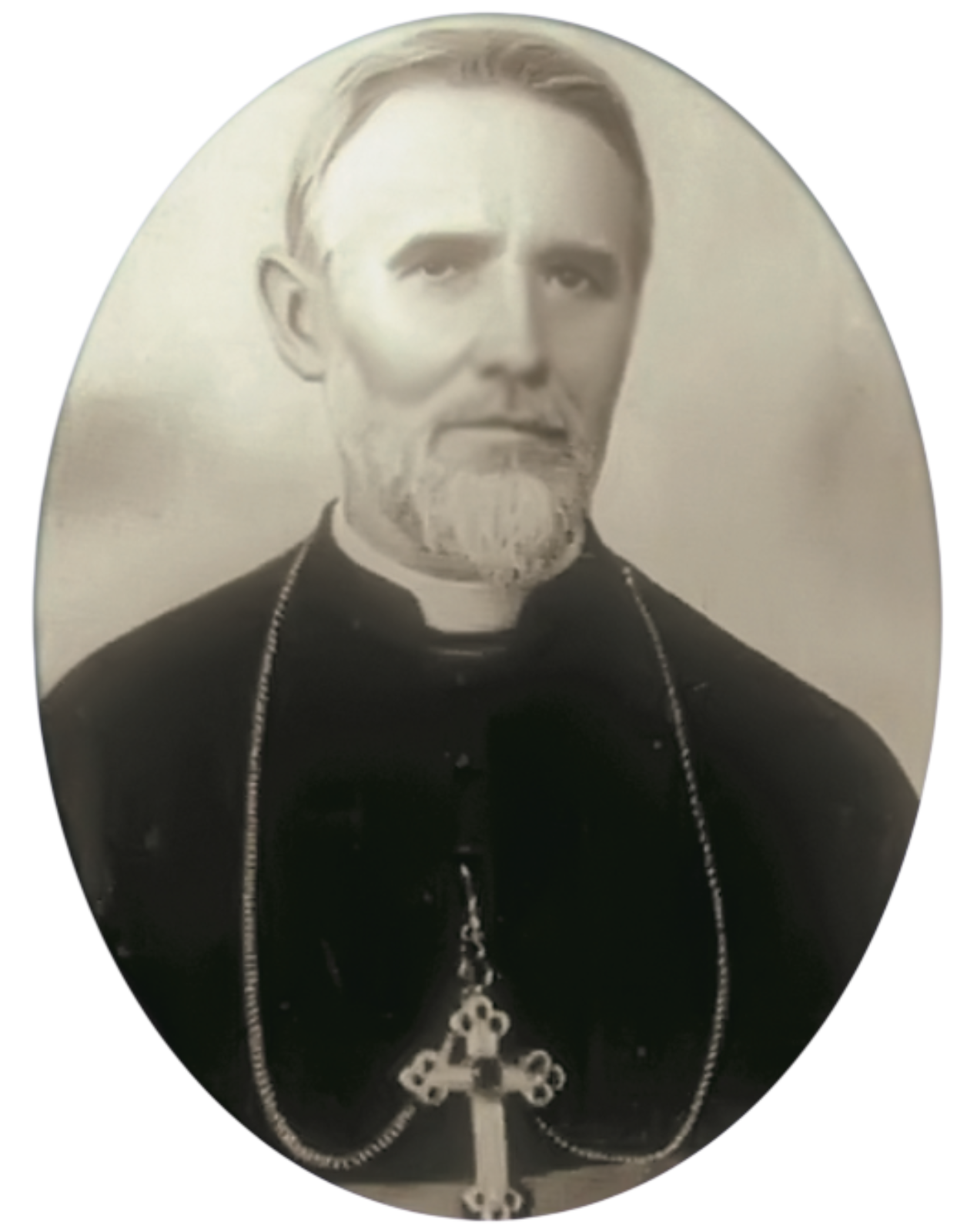
Bishop Timothy John Crowley, CSC
THE FOUNDER BISHOP TIMOTHY JOHN CROWLEY, CSC, (1929-1945)
- Name : Bishop Timothy John Crowley, CSC
- Date of Birth : January 16, 1880
- Birth Place : Kilmaloc of Limeric Counti, Ireland
- Entrance to the seminary : October, 1897, Notre Dame University, Indiana, America.
- Perpetual profession : August 15, 1904.
- Ordained Priest : August 2, 1906 (Congregation of Holy Cross)
- Missionary journey to Bengal : November 6, 1907.
- Appointed Coadjutor Bishop of Dacca : January 26, 1927
- Succeeded as Bishop of Dacca : November 9, 1929
- Death : October 2, 1945 (at age 65)
- Buried in : Luxmibazar Church.
Bishop Legrand resigned on November 11, 1929 and Bishop Crowley took over responsibility for the diocese. At the time of his resignation Bishop Legrand was the oldest bishop of British India. Fr. Timothy Crowley, CSC, had gone to the USA from Ireland at an early age. After joining Holy Cross, he obtained his doctorate at The Catholic University of America and was teaching English at the University of Notre Dame when he was sent to East Bengal in 1907. He had served in several parishes and spent five years as Headmaster at St. Gregory’s High School. He had been Vicar General from 1916 to 1925, when he was appointed coadjutor bishop. From 1923 to 1927 he was Religious Superior of Dacca Holy Cross religious, living at Toomilia. He was “a zealous missionary, capable teacher and an able administrator.” Rev. Bishop Timothy John Crowley, CSC, is the founder of the congregation, ‘The Associates of Mary Queen of Apostles’ (SMRA).
In 19 century there was a great political commotion in the Indian subcontinent against the British rulers. All government officers were Christians and the Catholic institutions were also prominent. But on the other hand, the local civil population, activists were oppressed, inferior and marginalized by the British imperial rulers. The rural poor people were victims of natural calamities every year. Distressed Indian women, especially the Hindu-Muslim women were confined to their homes, deprived of education and human dignity. In that a dark period of Indian history, Bishop Crowley had arrived bearing the light of Christ. Bishop Crowley was a person with compassion towards the lowly and downtrodden people and they found fatherly love in him. In 1915, while he was the pastor at Toomilia parish, he looked for other religious vocations to serve the poor of this region.
When Bishop Armand Legrand, CSC retired in his old age, Bishop Crowley was ordained as the 5th Bishop of Dhaka as his successor in November 11, 1929. At that time the Christian population in Dhaka diocese was around 10,0000 and there were only 40 catechists, which was not sufficient due to the growing needs specially in the tribal areas where there was a need for more priests, catechists and teachers. Evangelizing activities continue with enthusiasm, thanks to leadership of Bishop Crowley.
Bishop Crowley was active, hardworking and efficient and zealous in his pastoral and missionary commitment, influential among his people, undaunted by challenges, pious in prayer life, courageous and enduring in suffering. He was very much interested in using all possible means in order to communicate the Good News among Christians and non-Christians. He established more catechetical centers and appointed catechists to carry on the work of evangelization. He also published books, periodicals, booklets, leaflets and wrote circulars and pastoral letters which enhanced evangelization in whole Church of Bangladesh. Those small publications were distributed among Hindu and Muslims. Once he wrote,
We are more blessed than ‘St Francis De Sales’, because in his time there were lacking printing press. Today we have 50 printing presses only in Dhaka city. Dhaka is a city where there are a number of educational institutions as compared to other British-ruled cities in India, a great number of our young boys go to schools; therefore, the numbers of readers of our publications are many (The Bengalese, op. cit. (January 1942).
During the time of World War, I (1914-1918) and World War II (1943) and during natural calamities (Tornado in September 24, 1919) Bishop Crowley always stood by his people. He took all possible measures to protect his sheep from suffering. During the time of WW II, there was extreme famine and lack of food in East Bengal. Monsignor Michael D’ Costa wrote,
The World War has been continuing for two or three years…. Which started problems such as lack of food in the country and increased costs of commodities. The public restaurants did not continue doing business…. Vegetables, rice not available for the people. British Government would give all commodities for the soldiers. The numbers of beggar increased in the city. They suffer from hunger, died of starvation. The beggars in the villages tried to survive by eating the leftovers of the rich. The overwhelming sufferings of the poor continued until the war came to an end. It was the missionaries saved many of them by supplying wheat, flour, and rice. They collected food by applying to the S.D and Magistrates to save people from starvation and death.
In order to help the poor, Bishop Crowley wrote a Pastoral letter entitled “Endeavors to Overcome Famine” in October 1943. He wrote,
I acknowledge many of you for your almsgiving. I appreciate your cooperation with your pastor in our attempt to eliminate poverty… Every person is your neighbor. We should help him irrespective of race, creed and faith. I earnestly request you all men and women, catechists and teachers in each village, so that you will cooperate with your parish priests to eliminate the sufferings of the poor. It is collective work, not individual. We must perform this work having in mind unity among all the Presidents, Members of the Union Board, all Naebs, Staff of Thana, Sub-districts and Supply-Officers… Priests, Brothers, Sisters and all missionaries must help the poor and distressed as much as possible…
For his prudent initiatives in establishing solidarity and friendship, universal love for humanity for all Hindus, Muslims, and Christians, and being pleased by his great help to the poor and hungry population during the World War II, the British Government awarded him with a rare Golden Medal “Kaizer-E-Hind (first class award)”.
Bishop Crowley was the one who fulfilled the dream of his predecessor Bishop Legrand, CSC by establishing a new congregation with eight local girls. He named his new congregation “Associates of Mary Queen of Apostles” (SMRA). He entrusted this new entity to her patronage Mary Queen of Apostles. Bishop died in October 2, 1945 and was buried at Laxmibazar Church in Dhaka.